Gregorian year
A small experiment in knowledge · AUC
Ten months. No emperors.
October means eight. November means nine. December means ten. The names never updated. This page asks what happens if the year is put back in line with them.
I · The reckoning
How old are you, truly?
Spin one value at a time. Arrows, a click, or one mouse-wheel notch. No flying lists.
January 1, 1990
Scroll moves one step. Arrow keys do the same when a wheel is focused.
II · The mismatch
Twelve months, then ten.
September sits in slot 9. October in 10. The calendar disagrees with its own Latin.
True year
10 months · 303 days

Struck from the year
July was Quintilis. August was Sextilis.
Quintilis means fifth. Sextilis means sixth. In 44 BC the Senate renamed the fifth month for Julius Caesar. In 8 BC Sextilis became Augustus, and a day was taken from February so the emperor’s month would not be shorter than Caesar’s.
In this experiment those two months are set aside. The numbered months then sit where their names have always pointed.
III · The names
What the months still admit.

January · Ianuarius
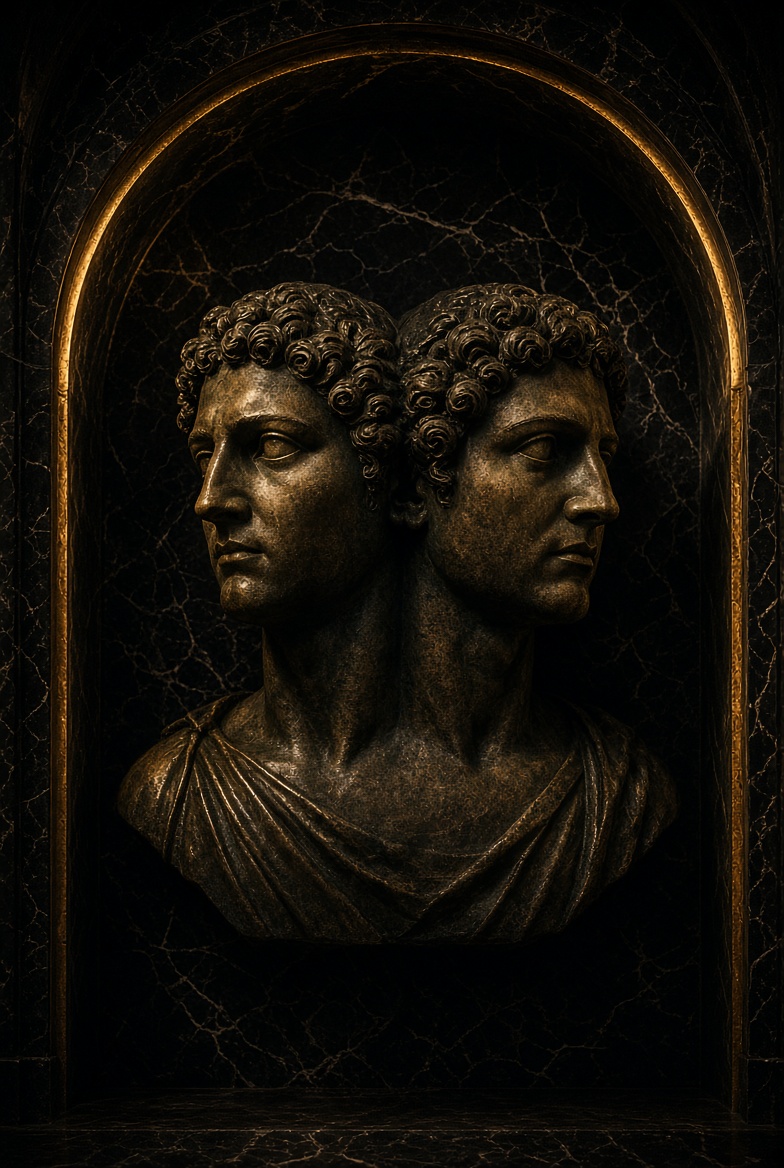
The god who looks both ways.
Janus has no Greek twin. His temple on the Forum was shut in peace and open in war, and it was almost never shut. A year is a threshold. Naming the first month for the god of doors is the most Roman thing on the calendar.
February is not named for cold. Februa were the mid-month purifications. The Luperci ran the city with goatskin thongs. It was the year’s scratch pad.
March
Martius · IIIMars, before he was only a war god, watched the fields. When the year began here, armies and ploughs could move again. March was the original first month.
April
Aprilis · IVLikely from aperire, to open: buds, soil, eyes. An older folk link to Aphrodite is prettier, and less trusted.
May
Maius · VMaia, growth, the elders (maiores). A month for what is already rising.
June
Iunius · VIJuno, or the juniors (iuniores). Marriage month, threshold of summer, last of the old named months before the numbers begin.
September
septem · VIISeven. Not nine. The longest-lived confession on the calendar.
October
octo · VIIIEight. The name did not move when the months did.
November
novem · IXNine. Still saying so, quietly, on every phone.
December
decem · XTen. The last month, if you stop where the counting stops.
IV · Two compatible readings
The experiment, and the older year.
Both start from the same clue: four months are still numbered for a ten-month year.
This page
Exile the emperor months.
Strip July and August, keep the other ten at their modern lengths, and September is seventh, October eighth, November ninth, December tenth. The arithmetic of age uses a 303.2425-day year, about 62 days shorter than the Gregorian one. That is why a true age runs ahead.
The older account
Winter was left uncounted.
The usual historical reading is different, and worth keeping beside the experiment. The Romulan year began in March, ran ten months, about 304 days, and simply did not number deep winter. Numa is credited with adding January and February. July and August were renames of Quintilis and Sextilis, not brand-new insertions — though a day was later moved to flatter Augustus.
The gap
About 61 unnamed days.
A solar year is roughly 365 days. A 304-day calendar leaves a dark remainder. Farmers still knew winter. The state just declined to give it a name. Later reformers filled the gap, then the emperors signed two of the months.

V · How the year was edited
Four revisions. One leftover.
Romulus, by tradition
Ten months from March, winter unnamed. The numbered months are born here: the seventh through the tenth.
Numa fills the dark
January and February are added. The year becomes lunar, about 355 days, with an occasional extra month, Mercedonius, tucked after February when priests felt like it. The calendar could be politically delayed.
The Year of Confusion
Caesar’s Julian reform makes 46 BC last 445 days to drag the seasons back. Quintilis is renamed the next year. The sun is finally the ruler. The names are not.
Augustus will not be shorter
Sextilis becomes August. A day moves off February. From here, the flattery is structural.
Gregory fixes the leap years
Three leap years drop out of every four centuries. Easter stays near the equinox. The twelve-month frame is inherited, not questioned. The most accurate civil calendar still mislabels four of its months.

Neighbor experiments
Other people have tried this.
The French Republican calendar of 1793 threw out saints and emperors for twelve 30-day months of weather and tools: Vendémiaire, Brumaire, Thermidor. It lasted until 1806. The Soviet five-day week tried to abolish Sunday. Both failed. The Roman number-names did not. They are still in the phone in your pocket, slightly wrong, and still precise.
Weekday names are a different pile: Sun, Moon, Tiw, Woden, Thor, Frige, Saturn. They never promised to count the months.
The names are not wrong. The calendar is — or the year began in March, and winter had no name. Either way, October is still eight.